
Future Homes Standard 2025: What Will Replace Gas Boilers in New Homes?



The UK housing sector is on the brink of major change. Under the Future Homes Standard 2025, new homes will no longer be fitted with gas boilers. Instead, developers must choose low-carbon heating systems that comply with stricter building regulations and support the transition to net zero.
This raises two key questions for developers and contractors:
What will replace gas boilers?
Which heating system is best for new housing developments?
The Future Homes Standard Explained
The UK government has confirmed that all new homes built from 2025 must meet the Future Homes Standard (FHS), requiring a 75–80% reduction in carbon emissions compared with current regulations. To achieve this, fossil fuel heating systems - including gas boilers - cannot be specified in compliant new-build projects.
While this requirement does not affect existing homes, it represents a decisive shift in regulation and market expectations. Developers who continue to design homes around gas risk delivering properties that quickly fall behind regulation, consumer demand, and market value.

When Are Gas Boilers Being Phased Out?
Gas boilers are being removed from new-build homes, but there is no confirmed phase-out date for existing households.
From 2025, new homes cannot be fitted with traditional gas boilers if they are built to the Future Homes Standard. Developers will instead need to install low-carbon heating systems such as ground or air source heat pumps.
For existing housing stock, the government has not introduced an outright ban. Earlier proposals for a 2035 phase-out of gas boilers have been dropped, and there is currently no confirmed date for ending gas boiler sales.
Current policy focuses on encouraging the uptake of low-carbon alternatives - particularly heat pumps - through incentives such as the Boiler Upgrade Scheme.
In practice:
- New homes (from 2025): Gas boilers cannot be installed in homes built to the Future Homes Standard. Developers must use low-carbon systems like ground source heat pumps.
- Existing homes: Gas boilers remain legal for repairs and replacements, but incentives and policy pressure are pushing households toward low-carbon heating.
The message for developers is clear: the transition away from gas in new homes has already begun - and the future of home heating lies in proven low-carbon systems, especially heat pumps.
Why Gas Boilers Are Being Replaced in New Homes
- High carbon emissions: Heating accounts for nearly 40% of UK energy use, with gas still the dominant fuel.
- Inefficiency: Even modern boilers waste heat and keep homes tied to volatile gas prices.
- Policy drivers: Net Zero 2050, the Future Homes Standard, and Part L of the Building Regulations all push towards low-carbon heat.
- Consumer expectations: Buyers increasingly seek quiet, efficient, low-cost heating systems.
What Will Replace Gas Boilers in 2025?
For new-build developments, gas boilers will be replaced largely by heat pump-based systems, particularly ground source heat pumps (GSHPs) and air source heat pumps (ASHPs).
Government consultations and industry experts widely agree that heat pumps will form the backbone of low-carbon home heating in new builds.
Ground source heat pumps, in particular, deliver exceptional efficiency, reliability, and long-term value - making them ideal for developments with multiple homes.
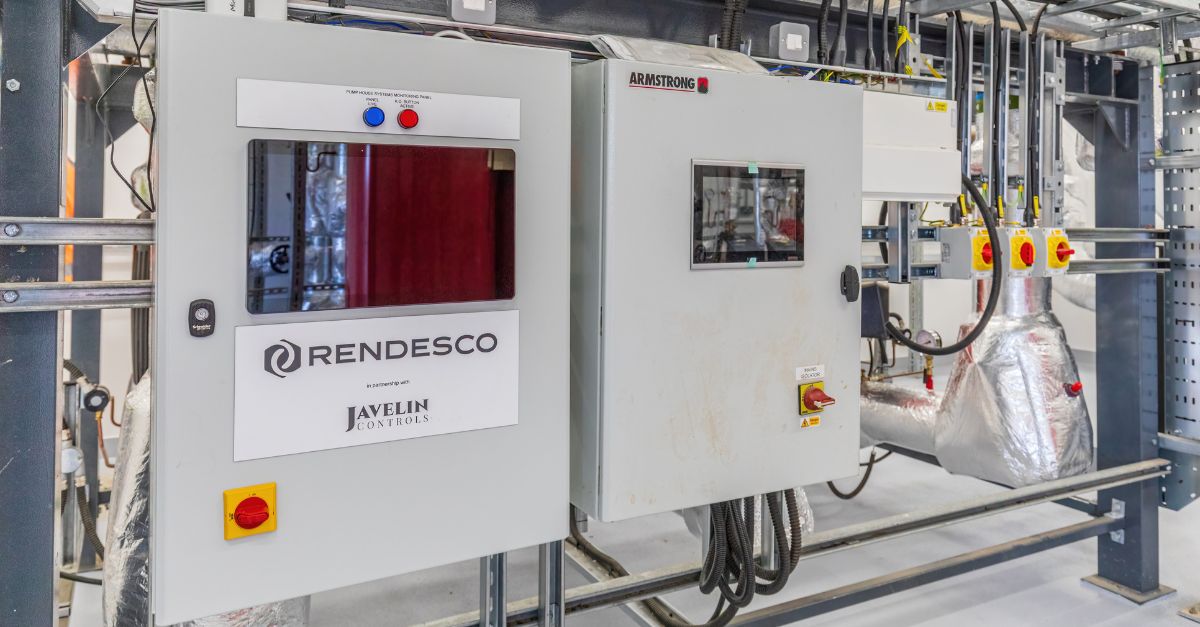
Ground Source Heat Pumps (GSHPs)
Ground source systems extract heat from the ground through boreholes or slinkies. They deliver:
- Efficiency: Seasonal COP often above 4.0
- Lower running costs: More predictable than ASHPs
- Silent operation: No external fans or visible units
- Scalability: Ideal for networks across medium and large developments
- Longevity: Ground arrays last 100+ years; plant equipment lasts 20-25 years
At Rendesco, we deliver networked GSHP systems that are fully funded, owned, and operated by a regulated utility - cutting upfront costs for developers while giving homeowners cheaper, steadier bills.

Read more: The Benefits of Geothermal Heat Networks
Air Source Heat Pumps (ASHPs)
Air source heat pumps (ASHPs) extract heat from the outside air and are generally easier to install than ground source systems, but they are less efficient in cold weather, rely on external units that can raise planning concerns, and their running costs are more sensitive to electricity tariffs.
Heat Networks
District and community heating systems are gaining traction in dense developments. They can be powered by:
- Ground source heat pumps
- Waste heat
- Other low-carbon sources
They require careful planning and strong long-term operational partners.
Hydrogen-Ready Boilers
Hydrogen-ready boilers are often discussed, but:
- There is no clear timeline for hydrogen heating
- Large-scale hydrogen networks remain uncertain
For developers building today, hydrogen is not a viable solution for new homes.
Direct Electric & Biomass
- Direct electric: Simple but expensive at scale; suitable only as backup.
- Biomass: Limited by emissions, maintenance, and supply chain constraints.
Read more: Anywhere Gas Can Work, Heat Pumps Can Work: Rendesco Challenges Myths on Clean Heating
Design & Integration Considerations
Switching to low-carbon heating requires early planning:
- Space: Plant rooms, risers, and energy centres
- Grid capacity: Heat pumps increase electrical demand
- Thermal storage: Reduces peak demand
- Controls: Essential for real-world efficiency
- Phasing: Boreholes can be installed early to avoid programme delays
Economic Considerations
- Upfront costs: GSHPs are capital-intensive, but funded models remove this burden
- Running costs: With SCOP above 4, GSHPs outperform ASHPs over the life cycle
- Risk: Fewer call-backs, noise complaints, and retrofit issues
- Value: Homes with low, steady bills attract buyers and hold long-term value
Risks and How to Mitigate Them
- Installer shortage: Use proven turnkey partners who design, drill, install, and maintain in-house
- Policy uncertainty: Choose systems already compliant with the Future Homes Standard
- Grid strain: Mitigate with smart controls and thermal storage
- Performance gap: Ensure strong commissioning and remote monitoring

Which System Should Developers Choose?
- Small, low-density plots: ASHPs may work but bring noise and running cost risks
- Medium to large developments: Networked GSHPs offer the best balance of cost, efficiency, and reliability
- Urban or mixed-use schemes: Heat networks powered by GSHPs or waste heat
The removal of gas boilers from new homes is not just a challenge - it is an opportunity. Developers who adopt ground source heat pumps early will deliver homes that meet regulation, satisfy buyers, and stand out in the market.
Conclusion
Gas boilers are no longer permitted in new homes built to the Future Homes Standard from 2025. While ASHPs, heat networks, and emerging options like hydrogen-ready boilers all have roles, ground source heat pumps remain the most efficient, reliable, and future-proof solution for developers.
By planning early, working with the right partners, and choosing proven low-carbon systems, developers can not only comply with new regulations but also build homes that perform better, sell faster, and last longer.
Next Steps
If you have an upcoming development and want to understand whether ground source heat pumps are the right fit, our team can help. Contact us for a free, no-obligation discussion at enquiries@rendesco.com.