
How Much Space Do You Really Need for Borehole Drilling for Ground Source Heat Pumps?


Borehole drilling for ground source heat pumps (GSHPs) is often one of the biggest unknowns for developers at early design stage. Questions about space, access and disruption frequently arise, especially on constrained or urban sites.
In practice, borehole drilling for GSHPs is far more flexible than many expect. With early planning, it can be integrated into most new-build sites without compromising layout, programme or buildability.
This article explains the real space, clearance and access requirements for borehole drilling for ground source heat pumps, and how it fits into a typical development programme.
What Borehole Drilling for Ground Source Heat Pumps Involves
Borehole drilling is the method used to install the vertical (or inclined/radial) ground loops that supply renewable heat to a ground source heat pump system. A drilling rig creates boreholes 150mm in diameter, and typically between 150 and 250 metres deep. Pipework is installed into each borehole and connected underground to form a closed-loop system.
Most of the work happens below ground. The surface impact of borehole drilling is temporary and limited to the drilling phase. Once complete, the ground can be reinstated and built over, with no visible infrastructure remaining.
Typical Borehole Drilling Footprint for GSHP Systems
Drilling Rig Footprint
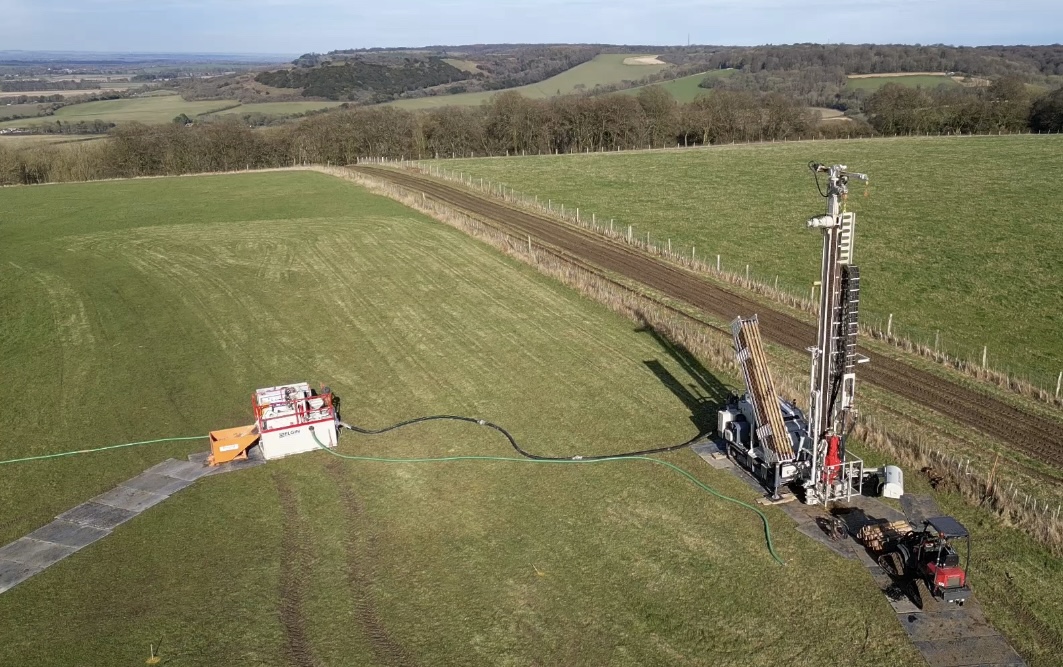
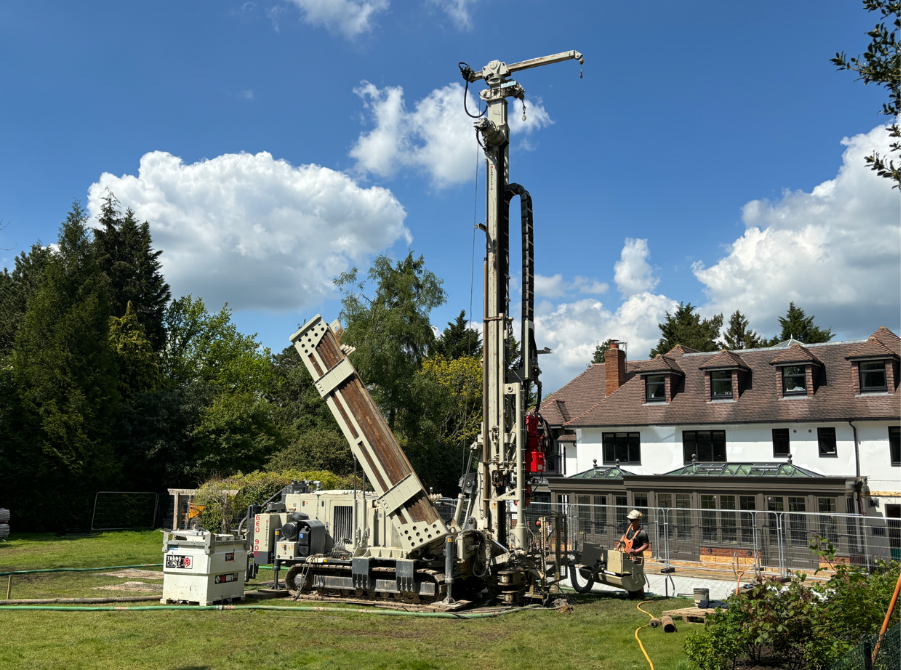
For borehole drilling associated with ground source heat pumps, a standard drilling rig usually requires a working area of around 10m x 10m. Additional clearance is needed around the rig for safe operation, handling pipework and crew access.
Vertical clearance is also important. Most rigs require approximately 10 metres of headroom, which should be checked early where trees, overhead services or existing buildings are present.
Incline (or radial) drilling from Rendesco requires less space than typical vertical drilling and allows multiple boreholes to be drilled from a small platform at the surface.
Access Requirements
Access for borehole drilling rigs is often more manageable than expected. A clear route is required for the rig and support vehicles, typically around 3-4 metres wide, with suitable ground bearing capacity.
Borehole Drilling on Tight or Constrained Sites
Borehole drilling for ground source heat pumps does not require large open areas. Boreholes can be installed beneath roads, car parks, courtyards and landscaped areas. They are often drilled before foundations are poured and later built over.
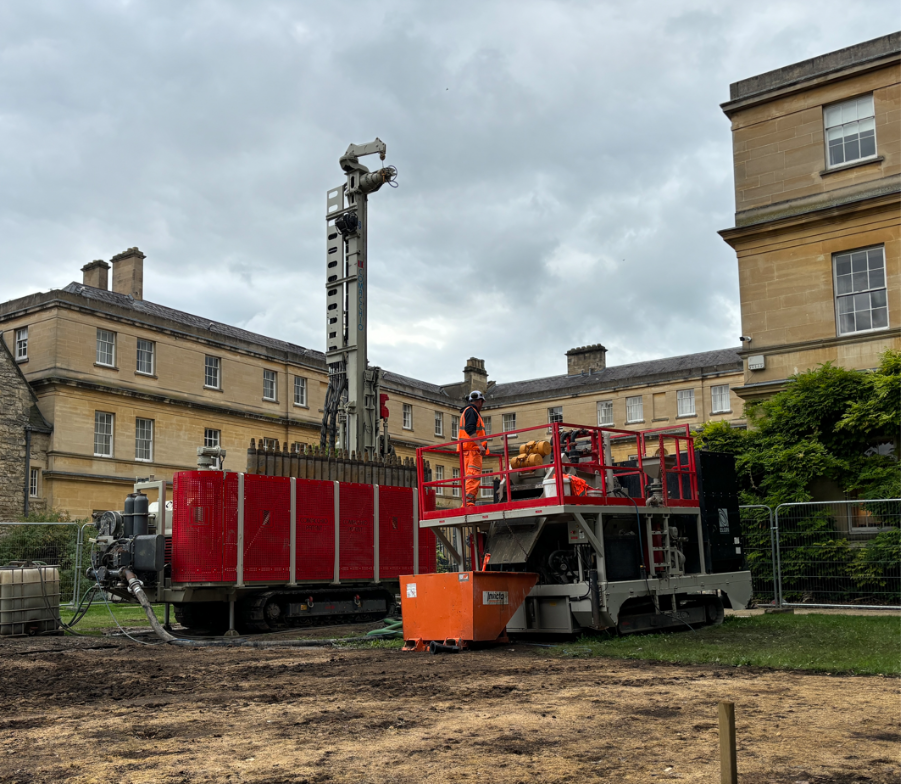
This approach makes GSHPs viable even on constrained sites. A good example is Rendesco’s work at Trinity College University of Oxford, where borehole drilling was successfully delivered within a highly constrained historic environment. Despite limited space and access, boreholes were installed and reinstated with minimal surface impact.
On urban and space-restricted sites, borehole drilling is often phased to align with the construction programme, allowing development to continue without delay.

When Borehole Drilling Fits into the Build Programme
Borehole drilling for ground source heat pumps is typically carried out during early groundworks or enabling works. Installing boreholes early reduces the risk of clashes with foundations, services or landscaping.
Early drilling also allows the ground loop to be completed, tested and protected before main construction progresses, helping safeguard the overall programme.
Common Misconceptions About Borehole Drilling for GSHPs
One common misconception is that borehole drilling needs large areas of open land. In reality, boreholes occupy very little permanent space and can sit beneath finished surfaces.
Another misconception is that borehole drilling delays construction. When planned early, drilling runs alongside other enabling works and does not slow the build programme.
Some also assume drilling is highly disruptive. In practice, borehole drilling is a managed, short-term activity with limited impact compared to many other construction processes.
Why Early Planning Makes Borehole Drilling Easier
Early planning is critical to successful borehole drilling for ground source heat pumps. When boreholes are considered at layout and masterplanning stage, they can be positioned to avoid clashes and make efficient use of available space.
Early coordination with groundworks, utilities and access planning reduces risk, improves efficiency and helps control cost.
Read more: Why Early Adopters of Ground Source Heat Pumps Will Lead the New-Build Market
How Rendesco Delivers Borehole Drilling for GSHP Projects
At Rendesco, borehole drilling is planned as part of the wider ground source heat pump strategy. We coordinate drilling with groundworks, utilities and construction activity to minimise disruption.
Our in-house Design and Drilling departments seamlessly work together to allow us to design and drill borehole layouts that work on both open and constrained sites. Rendesco also offer full funded ground source heat pump systems, reducing upfront cost and risk for developers.

Conclusion
Borehole drilling for ground source heat pumps does not require excessive space and is rarely a barrier to adoption. With early planning and the right delivery approach, borehole drilling can be integrated into most new-build sites - including constrained urban environments.
Understanding the real requirements allows developers to plan with confidence and unlock the long-term benefits of GSHP systems.
Next Steps
If you’re considering a ground source heat pump system - whether for a new build or retrofit - and want to understand how borehole drilling would work on your site, contact our team for a free, no-obligation assessment at enquiries@rendesco.com.